
Consolidated Sustainability Report 2025
Highlight
The Consolidated Sustainability Statement is the document through which the activities carried out by the Sella Group in the field of sustainability are reported. It is prepared in accordance with Legislative Decree No. 125/2024, which transposes Directive (EU) 2022/2464, as well as in compliance with the European Sustainability Reporting Standards (ESRS) issued by EFRAG (European Financial Reporting Advisory Group).
Since 2004, the Sella Group has prepared its Social Responsibility Report, while from 2017 to 2023 it published the Non-Financial Statement pursuant to Legislative Decree No. 254/2016, in accordance with the Global Reporting Initiative Sustainability Reporting Standards issued by the Global Reporting Initiative (GRI).
The Consolidated Sustainability Statement is subject to limited assurance by the company appointed from time to time to perform the statutory audit. The information reported, relating to the 2025 financial year (1 January - 31 December), was identified through the double materiality assessment process required by the ESRS, aimed at identifying the ESG matters that are material to our business and stakeholders.
Economic value generated and distributed by the Group in 2025
1.412 mln economic value generated
(+118 mln compared to 2024)
1.153 mln distributed economic value
(+111 mln compared to 2024)
Environment
Discover more »
* Related to their own operations (so-called own emissions) resulting from the purchase of office supplies and office machines, waste generation and disposal, upstream activities of Scope 1 and 2 associated with fossil fuels and electricity (so-called emissions from energy vectors), business trips made by employees and, starting from 2021, commuting.
Real estate collateral
People
Discover more »
Community and Territory
Discover more »
* These funds annually allocate a portion of their assets to charitable initiatives.
Customers
Discover more »

Selected excerpts from the tribute dedicated to Maurizio Sella, who passed away on the evening of 22 November 2025, as reported in the Consolidated Financial Statements within the Sella Group’s Annual Report.
“There is no better way to succeed than by helping others succeed.”
Maurizio Sella (1942–2025)
Until the very end, Maurizio Sella dedicated every moment to working for the company, for his family and for institutions, serving as an example of dedication, wisdom, long-term vision and entrepreneurship.
“It is to him – said his sons Pietro and Federico when announcing the news – that we owe the success of the Group in which we work, which he guided towards solid and lasting growth by translating family values into human, ethical and entrepreneurial principles in which we identify and which guide our work every day. He has left us a great moral legacy, made up of teachings, determination, hard work and trust in the future, and his strength, his example and his integrity are, and will always be, our distinguishing features.”
The success of these results and of this journey also – and above all – lies in the multiplication and sharing of opportunities: it is not an individual achievement, but rather reflects the ability to create value for an ecosystem that grows only if those around us grow as well. Thinking of others – whether employees, customers, suppliers or communities – is an essential part of a deep value creation strategy: it builds trust, strengthens reputation and ensures continuity. The history of the Sella Group – which in 2026 celebrates one hundred and forty years and is rooted in centuries of family entrepreneurial history – clearly demonstrates this.
Today, those who do business are called upon to build a long-term mindset in an era dominated by immediacy: to carry values beyond contingency, to choose durability over convenience, and to build relationships that endure through transitions. In other words, it means asking whether what we do today will stand tomorrow, whether what we promise today will remain even as economic cycles, technologies, generations and expectations change. It means thinking with a long-term perspective, managing the urgency of today without betraying responsibility for tomorrow, turning every decision into an act of trust that can be passed on, and making success a chain of opportunities rather than a solitary peak.
The Sella Group is guided by the awareness that economic results cannot be separated from consideration of the environmental and social aspects connected to its activities. For this reason, over the years it has developed initiatives and policies dedicated to sustainability issues and is committed to a process of progressively integrating environmental, social and governance aspects into its activities and relationships with stakeholders.
During the year, the Group obtained sustainability ratings for the first time from two leading international organisations: Standard Ethics and CDP – Carbon Disclosure Project.
Standard Ethics, a specialised agency for the assessment of sustainability and corporate responsibility policies, assigned Gruppo Sella a Corporate Standard Ethics Rating of EE- (Adequate) and, considering the robustness of the path undertaken and its medium- to long-term improvement prospects, also assigned a Long Term Expected Rating of EE+ (Very Strong). These assessments highlight a significant positioning among unlisted Italian banks.
CDP (Carbon Disclosure Project), an international organisation active in more than 50 countries and globally recognised for measuring environmental performance, assigned Gruppo Sella a B score (Climate Change). This positive assessment confirms the Group’s commitment to managing climate risks, ensuring transparency in environmental data, and progressively strengthening its climate change initiatives.
In addition, to monitor its commitment, the Group has adopted a number of indicators, including:
B Impact Assessment SCORE
The Group has been consistently measuring the impact of its environmental, social and governance performance for several years using the B Impact Assessment (BIA) methodology, which assesses five areas: environment, workers, customers, community and governance, assigning a final score ranging from 0 to 200. According to the B Impact Assessment methodology, a score above 80 represents the threshold established for organisations that meet the requirements defined by the framework.
The result of this self-assessment, which the Group undertook with the support of Nativa Srl Società Benefit, a company specialised in supporting businesses in their sustainability journeys, has improved over time, also thanks to a series of initiatives included in a dedicated multi-year action plan. In recent years, the Group has consistently achieved results above the threshold of 80, reaching a score of 96.6 at the end of 2025.
SUSTAINABLE INTERMEDIATED VOLUME
In order to measure its progress in supporting initiatives, projects and organisations that meet the ESG criteria defined through the methodology adopted by the Group and identified on the basis of management assessments, since 2021 the Group has adopted an internal measure called “sustainable intermediation”, used to provide a single view of the percentage of total loans, customer investments and the Group’s proprietary securities represented by sustainable activities.
During 2025, also in consideration of the evolving regulatory framework, the Group decided to adopt updated and more selective criteria* for the classification of investments according to customers’ sustainability preferences.
Based on the new criteria, the value of sustainable intermediation in 2025 was 32.3%, an increase of 3 percentage points compared to the 2024 figure (29.3%), which was recalculated to ensure comparability over time.
ECONOMIC VALUE GENERATED
A quantitative view of the impact generated by the Group’s activities is provided by the economic value generated, which offers a basic indication of the wealth created by a company. Based on this figure, the economic value distributed is determined, representing the portion allocated to remunerating the various stakeholders. The calculation of economic value generated and distributed is based on the ABI Guidelines, which propose a reclassified income statement model prepared in accordance with Italian accounting standards for the banking sector.
Using this reclassification methodology, the economic value generated by the Group in 2025 amounted to EUR 1,411.6 million, an increase of EUR 117.8 million compared with 2024.
82% of this amount was distributed among the various stakeholders, for a total of EUR 1,153.2 million, up EUR 111 million compared with the previous year. Over the last nine years, the Group has continuously increased the amount of value distributed, recording an increase of more than EUR 636 million between 2017 and 2025.
* The self-regulation criteria applied from 2025 provide for identifying an investment product as sustainable according to the criteria adopted by the Group as follows:
- asset management products (UCITS, portfolio management services, insurance products and ETFs) classified under Article 8 or Article 9 of the SFDR Regulation, issued by companies that have received a positive ESG due diligence assessment and meet the requirements defined by the internal methodology;
- Green, Social and Sustainability Bonds;
- corporate equity and bond instruments issued by issuers that meet specific ESG requirements.
Sella Group is aware that safeguarding the environment is a priority and that adopting behaviours aimed at reducing environmental impacts and contributing to climate change mitigation objectives, for the benefit of future generations, is a necessary prerequisite for healthy and sustainable long-term development and a responsibility shared by all, businesses and citizens alike.
Environmental sustainability therefore refers to the concept of responsibility towards others and, in particular, towards future generations: a moral responsibility even before it is a legal one.
With this in mind, the Group’s approach integrates environmental and climate considerations into its operational and financial intermediation activities through the monitoring and improvement of its environmental performance by means of defined objectives and indicators.
The strategy to address climate change is therefore twofold:
- supporting customers in their transition journey through advisory activities, combined with a broad range of dedicated products and services and the support of initiatives and activities that contribute to achieving this objective;
- reducing its own CO₂ emissions (so-called “own emissions”) and their related impacts. Building on the initiatives already implemented and the results achieved, the Group continues the implementation of a climate mitigation plan based on a science-based decarbonisation pathway, developed according to methodologies consistent with the SBTi guidelines and exceeding the requirements for alignment with the 1.5°C target established by the Paris Agreement.
In line with the strategy to address climate change, approved by the Board of Directors of the Parent Company Banca Sella Holding, decarbonisation targets have been defined for both the Group’s own greenhouse gas emissions and portfolio emissions, differentiated according to the source of the emissions, together with the actions required to achieve them. The targets were identified taking into account the regulatory and geopolitical framework in place at the date of approval, the potential significant evolution of which may require future revisions.
With reference to the environmental impact of the Group’s portfolio, alongside the broader vision that guides the Group in considering sustainability aspects in its intermediation activities, in 2025 a transition plan was defined for high climate-impact sectors, involving both the lending portfolio and the financial assets held in the proprietary portfolio.
The high climate-impact sectors for which medium- and long-term targets have been defined, in line with the Net Zero climate scenarios of the International Energy Agency (IEA), are: energy, fossil fuels, the automotive sector, air transport, maritime transport, cement production, iron and steel production, and chemical manufacturing. In addition, the Real Estate sector, understood as properties serving as collateral for mortgages or leasing arrangements, has been included. For this sector, targets have been defined for new financing aimed at progressively steering the lending portfolio towards highly energy-efficient properties, thus contributing to the decarbonisation of the sector.
The main strategic levers for achieving these results consist of supporting customers in their transition through an appropriate offering of products and services, strengthening active engagement, integrating ESG factors into credit assessment and lending processes, and promoting ESG culture within the organisation.
For actions to support customers' transition, please refer to the section on Customers.


Within the scope of the Group’s own emissions (own emissions), based on the analysis of the climate scenarios identified by the IPCC to limit global warming to 1.5°C, as provided for by the Paris Agreement, science-based targets for 2030 have been identified. To this end, emission reduction targets for 2030 have been defined, using 2022 as the base year, expressed in absolute terms for Scope 1 and Scope 2 emissions.
In order to achieve these objectives, the Group has defined and launched a transition plan which, in line with the environmental guidelines set out in the Sustainability Policy, is based on the following decarbonisation levers:
- conversion of fossil fuel boilers through the installation of electric heat pumps serving headquarters and branch offices;
- modernisation of heat distribution networks in headquarters buildings;
- replacement of the refrigerant gases used in the air-conditioning systems of headquarters and branches with alternatives having a lower environmental impact;
- reduction of energy consumption and improvement of energy efficiency;
- generation of electricity from renewable sources through Group-owned facilities;
- initiatives aimed at reducing emissions associated with corporate mobility.
In continuity with the activities already carried out in previous years, actions related to the various decarbonisation levers continued throughout 2025.
With reference to the buildings used by the Group, the main actions and initiatives implemented during the year were:
- replacement of fossil energy sources with renewable energy sources through the electrification of a number of gas-powered heating plants serving both headquarters and branches;
- replacement of windows and fixtures in the guest accommodation facilities at the property complex located at Via Italia 2, Biella;
- replacement of lighting systems with LED technology both at the Group headquarters and in several branches;
- optimisation of workspace usage (space management) within headquarters buildings;
- continuous attention to energy consumption in order to avoid waste.
The Group has also chosen to adopt the LEED® (Leadership in Energy and Environmental Design) protocols developed by the US Green Building Council (USGBC) and recognised internationally. The buildings currently certified are:
- the Group’s main headquarters in Biella, Piazza Gaudenzio Sella 1, certified Gold since 2024;
- the Group’s headquarters in Turin, Corso Galileo Ferraris, certified Platinum since 2025;
- the Group’s main headquarters in Milan – S32, certified Platinum since 2018.
A further decarbonisation lever for the Group is the use of renewable sources for electricity generation. To date, all (100%) of the electricity purchased and used by Gruppo Sella in Italy and abroad is certified “green energy” with a Guarantee of Origin, generated from renewable sources, thanks to the inclusion from 2025 of India, the United Kingdom and Germany within the scope of coverage.
In addition, in line with its strategic guidelines, the Group has chosen to make significant investments in electricity generation from renewable sources through Group-owned facilities. At the end of 2025, installed capacity reached 10.6 MW, an increase of 6.7 MW compared with 2024, representing a significant increase in installed capacity compared with the previous year. To date, there are 35 photovoltaic systems installed at the Group’s buildings and branches, which produced 3,406,504 kWh during 2025 (+316% compared with 2024). This figure increases to 3,623,619 kWh when also considering the contribution of the hydroelectric plant located at the Group’s premises in Biella, Via Milano 1, which became operational in March 2024. Overall, 24% of the renewable energy generated (photovoltaic and hydroelectric) was self-consumed, with an estimated CO₂ emission reduction of 257,290 kg, calculated according to the methodology adopted by the Group. The above-mentioned facilities are equipped with dedicated monitoring systems that record both kWh production and the amount of CO₂ emissions “avoided”.
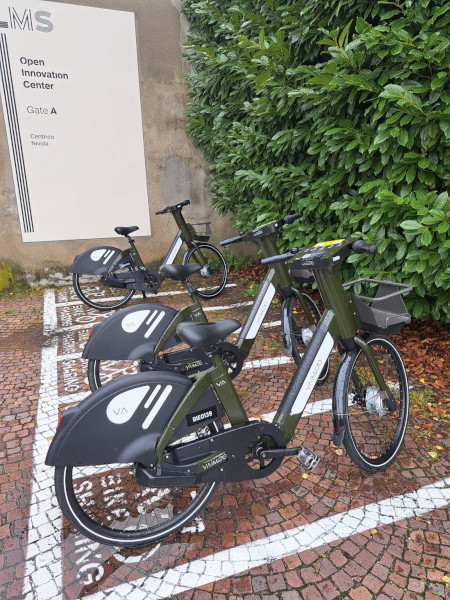
With regard to sustainable mobility, the Group has set the objective of reducing the environmental impact associated with travel, both from its company car fleet and from business travel and commuting, entrusting this responsibility to three internal Mobility Managers.
In addition to the annual preparation of the Home-to-Work Travel Plan, in 2025 the Group’s Mobility Manager, together with the relevant Departments and Offices within the Group, focused on the following initiatives:
- continuous updating of the company car list by increasing the share of green vehicles; in parallel, the definition of a new support and guidance process for drivers, aimed at steering choices towards more sustainable cars: in 2025, orders for plug-in hybrid and electric vehicles accounted for 73% of total new orders;
- organization of two contests to encourage the use of the KintoJoin carpooling app, which also provides dedicated parking spaces at the main Head Offices;
- promotion of the use of e-bikes and traditional bicycles;
- incentives for the use of local public transport within Banca Patrimoni Sella & C.;
- increase in electric vehicle charging stations, bringing the total number available to 42;
- information and awareness-raising activities on the environmental impact of different means of transport, using the Group’s internal communication channels.
Attention to environmental and sustainability issues also extends to suppliers.The objective is to give preference to suppliers that adopt sustainable management practices and technologies and provide products and services with a lower environmental impact, where the nature of the supply makes this possible and appropriate, alongside the assessment of other requirements such as quality, reliability, reputation and price competitiveness.
Since the end of 2023, the Group has adopted a new Procurement & Cost Management procedure which, as part of the broader project to re-engineer and digitise the procurement process, requires significant suppliers of the Group’s Italian companies to accept the Gruppo Sella Code of Ethics and to be assigned an ESG score. This score is the result of a questionnaire that takes into account the seven core subjects of the UNI ISO 26000:2010 guidelines on Social Responsibility: organisational governance, environment, fair operating practices, labour practices and working conditions, human rights, community involvement and development, and consumer-related issues.
With regard to office supplies, the Group has long chosen to reduce the use of paper and toner by redesigning its internal processes from a digital perspective and by offering digital solutions to customers aimed at reducing the use of paper and consumables, such as the Sella Box service and the collection of biometric signatures at branches. Where printing remains necessary, office paper in A3 and A4 formats is selected based on the presence of specific certifications such as FSC, Ecolabel and ECF. The paper used for customer communications that are still sent in paper format is entirely recycled.
The Group considers investment in people to be fundamental and views them as its distinguishing element, acting through the following strategies:
- growth and development: enable the growth of Team Sella by fostering development paths capable of elevating the professional contribution of people and facilitating attraction and retention of talent;
knowledge and training: ensure the growth, dissemination, transmission and updating of Team Sella's skills necessary for the success of the business plan and for the future of the Group;
attraction and workplace: attracting the talent the Group is aiming for by offering the best experience of working in the Group, preserving strengths and transforming the work environment to continue to be competitive;
diversity & inclusion: making Sella a more inclusive and diverse environment at every level of it, oriented to embrace diversity thus ensuring greater value generation and cultural richness;
Makers: is the Sella Group's program that puts people at the center, transforming each employee into an engine of innovation and entrepreneurship.
In 2025, the identified relevant positive results were driven by several particularly significant initiatives:
- continuous development of Lynfa, the Sella Group’s academy: a learning environment that fosters networking among its participants, both internal and external to the Group, as a key driver of personal and professional development;
- consolidation of the new information system for Human Resources management;
- continuous measurement of the Trust Index across all countries where the Group operates: this index collects and measures the opinions and feedback of Sella Team members (on an anonymous and protected basis) regarding the working environment and corporate culture. In 2025, the Sella Group’s Trust Index reached 72 points, increasing by 1 point compared to 2024 and by 8 points compared to 2022. This result, together with the analysis of the Culture Brief conducted by Great Place to Work, enabled the Group to obtain Great Place to Work certification in all countries. Additionally, the survey results and the Culture Audit allowed the Group to be included in the Italian ranking of Best Workplaces 2025 among companies with more than 1,000 employees.


The Group considers diversity and inclusion to be relevant elements for its development. The Group promotes diversity- and inclusion-oriented initiatives and practices within its activities. As evidence of the Group’s good practices in this area, in July 2025, 10 Gruppo Sella companies – Banca Sella Holding, Banca Sella, Banca Patrimoni Sella & C., Centrico, Fabrick, Sella Broker, Sella Fiduciaria, Sella Leasing, Sella Personal Credit and Sella SGR – obtained the Gender Equality Certification (UNI/PdR 125:2022).
During 2025, several initiatives were carried out in this area:
- adoption of the Diversity and Inclusion in People Management Policy, which defines the principles and guidelines for achieving the objective of creating a merit-based working environment that promotes diversity, equity and inclusion for its people and, at the same time, encourages these principles among them;
- establishment of the Diversity and Inclusion Committee, a Group-level mechanism responsible for promoting diversity and inclusion and safeguarding meritocracy among the people working within Gruppo Sella, as well as ensuring the continuous and effective application of gender equality policies and support for women’s empowerment;
- a multi-year research project with the Università Cattolica del Sacro Cuore to study the phenomenon of economic violence in interpersonal relationships, with the objective of combating violence through risk mitigation. This initiative directly responds to the commitment undertaken by the Group in 2023 through its adherence to the Memorandum of Understanding signed between the Ministry for Family, Birth Rate and Equal Opportunities and the Italian Banking Association (ABI) for the prevention and combating of violence against women and domestic violence, thereby continuing the path already undertaken in 2020 with the signing of the “Carta della Donna in banca” and active participation in the activities promoted by the related ABI working group;
- renewal of its participation in the initiative launched by the M&M Association, aimed at making a public commitment in favour of gender equality at the events in which the Group is invited to participate;
- training activities dedicated to diversity and inclusion topics, continuing the work carried out in previous years.
The Group believes that making its services accessible to the widest possible number of users, in compliance with applicable regulations, is an essential aspect of its activities. Therefore, all Gruppo Sella companies have already embarked on a journey to make their websites accessible, making their accessibility statements available to users, as well as improving the accessibility of applications and documentation, thereby contributing to the reduction of digital barriers.
During 2025, a structured and in-depth approach was adopted for the design of development pathways and the sharing of development actions for the Group’s people.
With the aim of supporting people’s well-being within the organisation and maintaining high levels of motivation and engagement, the corporate welfare system available to all Italian employees was further enhanced and promoted during 2025, in continuity with previous years.
in line with its values and its role:
- promotes initiatives aimed at fostering entrepreneurship, the value of work, innovation and skills development, facilitating opportunities for dialogue and networking through an ecosystem designed to support growth and innovation journeys, including digital transformation processes;
- supports, promotes and implements initiatives for the benefit of local communities and territories, both through its own initiatives and in collaboration with the various organisations operating within them (public institutions, schools, trade associations, etc.);
- participates in the implementation of cultural initiatives linked to local communities and their development, including through charitable donations and sponsorships;
- supports and promotes social and solidarity initiatives for the benefit of the community, particularly in the territories in which it operates, both through financial support and volunteer activities;
- does not provide direct or indirect contributions to political parties, movements, committees and political organisations, nor to their representatives or candidates.
The Group maintains constant interaction with the communities concerned through various methods and initiatives. The following are some examples relating to key topics for the Group:
- stakeholder engagement process for assessing material impacts: every year, the Group invites communities and local stakeholders, including through a dedicated questionnaire available online on the Group’s website, to express their views on the significance of the impacts identified by Gruppo Sella in carrying out its activities;
- promotion of entrepreneurial culture: in particular through Sellalab, the Open Innovation platform through which the Group develops collaboration activities with companies, start-ups and local communities. Sellalab’s educational activities within local territories represent a way to foster the dissemination of knowledge and skills and to engage with local communities, understanding their needs and requirements that may be addressed through the services offered by the Group;
- financial education: promoting financial literacy is a fundamental pillar of the Group’s commitment to education and is aimed at students, professionals and businesses. To contribute to the education of students and young people, the Group carries out various initiatives, also with the support of leading organisations in the sector;
- organisation of volunteering initiatives: the Group, as well as its individual companies, organises volunteering initiatives throughout the year within local communities. The selection of the organisations with which it collaborates is based on a careful assessment of local needs and an evaluation of potential partners operating in the area.
Please find out more about the Group's initiatives to support the community and territory, visit Community and Territory.
In 2025, Gruppo Sella continued to develop initiatives, products, services and advisory activities to support customers and stakeholders in managing the sustainability aspects that are relevant to their activities. In line with its Sustainability Plan, the Group continues to integrate ESG aspects into its financial intermediation activities, expanding its offering of solutions dedicated to the sustainable transition.
Sustainable investments
The Group has long been committed to increasing customers’ awareness of how sustainability-related factors can be integrated into investment decision-making. To this end, it confirms its commitment to integrating ESG aspects into investment services through:
- the consolidation, within the asset management segment, of the range of products that are legally recognised as promoting sustainability or that have the objective of making sustainable investments;
- the monitoring of the ESG characteristics of customer portfolios for which investment advisory and portfolio management services are provided. In light of the continuous evolution of both the business and regulatory environment, Banca Sella and Banca Patrimoni Sella & C. (hereinafter also referred to in this paragraph as the Group Banks) define a sustainability target for assets under management at least on an annual basis.
During 2025, the Group continued to develop its product range in order to expand the offering of products that integrate ESG characteristics or are classified under Articles 8 and 9 of the SFDR. In particular, activities focused on:
- consolidating agreements with Asset Managers capable of offering sustainable investment products, making more than 2,800 Article 8 and Article 9 funds available to customers under the SFDR framework;
- expanding the range of captive UCITS and insurance products with ESG characteristics;
- converting a substantial part of the portfolio management offering towards “sustainable” strategies, making available 68 Article 8 mandates and one new Article 9 mandate under the SFDR framework;
- maintaining constant attention to the transparency of information available on distributable financial instruments and to the training of both head-office and network staff, enabling them to better respond to and satisfy customer needs.
This is complemented by the commitment of Sella SGR, which in 2025 launched 10 Article 8 funds under the SFDR Regulation, while four UCITS already included in the product range were converted into Article 8 products.
At the end of 2025, the products promoting ESG characteristics pursuant to Article 8 of the SFDR totalled 53, including mutual funds, funds of funds, target-date funds and the sub-funds of the Eurorisparmio Pension Fund.
The “Investimenti Sostenibili” Fund, on the other hand, has sustainable investment as its objective pursuant to Article 9 of the SFDR.
This commitment, which has deep roots over time, resulted in 98% of assets under management being invested in products classified as Article 8 or Article 9 under the SFDR by the end of 2025.
Sustainable proprietary securities
The Group has defined the principles and guidelines that inspire its proprietary investment activities from a sustainability perspective, complementing the essential financial assessments.
In integrating the sustainability factor into its proprietary investment strategies, the Group is primarily guided by the United Nations 2030 Agenda Sustainable Development Goals, seeking to promote those that can best be supported through portfolio management investment decisions.
In line with these principles, Gruppo Sella undertakes the following commitments in the management of its proprietary securities portfolio:
- promoting sustainable investments, according to the internal management methodology, by setting specific targets regarding holdings of ESG financial instruments (such as, for example, green bonds, social bonds and sustainability bonds);
- integrating ESG factors into investment decisions and reporting systems by monitoring portfolio composition through dedicated monthly reporting, including ESG ratings and the “E” score of proprietary securities;
- reducing non-sustainable investments by excluding issuers operating in controversial sectors identified under the Group’s internal methodology.
At Group level, sustainable investments (excluding government securities) within the proprietary portfolio amounted to €636.6 million in 2025, compared with a target for the year of €565.0 million, representing 28.7% of the overall corporate bond and mutual fund portfolio and an increase of €107.1 million compared with the value recorded at the end of 2024.
Sustainable lending
Sella Group is committed to developing initiatives and solutions consistent with its sustainability objectives and to offering solutions that support customers in managing aspects related to the transition and ESG objectives that are relevant to their activities. During 2025, the range of lending products supporting investments in the energy transition was further strengthened through green loans and mortgages designed to meet the specific needs of both individuals and businesses.
The assessment of the ESG profile of corporate customers is particularly relevant and aims to measure companies’ needs with respect to the transition. The mapping of the so-called “sustainable lending”, classified according to the internal ESG criteria adopted by the Group and aimed at verifying the achievement of one or more targets set out in the 2030 Agenda, has become an established part of the assessment of all credit applications related to investments. The “ESG Platform” procedure, in use since 2024, collects responses to a dynamic questionnaire issued to companies on ESG topics for the purpose of gathering information on CO₂eq emissions, which is necessary to determine the carbon footprint of the lending portfolio and to measure transition risk impacts. The outcome of the questionnaire, which includes questions designed to assess companies’ positioning on the main topics within the three areas of interest: Environmental, Social and Governance, is summarised in the ESG Score, which indicates the counterparty’s level of alignment with sustainability topics.
Alongside the offering of financing and insurance products, support and advisory activities continued during 2025 through both partnerships with leading organisations and a dedicated internal team, the “ESG Experts”. ESG Experts are technical specialists (environmental engineers and an agronomist) who support business customers in their transition journeys, with a primary focus on decarbonisation and improving energy efficiency.
For retail customers, the catalogue of products and services, which already covers both environmental and social topics, was further expanded in 2025 with the introduction of the new Mortgage for Purchase and Renovation with Energy Efficiency Improvement. This mortgage rewards choices aimed at improving the energy efficiency of buildings and complements the Green Bees service, which has been available free of charge since 2024. This service, created to actively inform customers about the opportunities and risks associated with the energy transition, is based on a digital platform providing advice on residential building renovation and is accessible through Internet Banking, the mobile app and branch offices.
The stock of loans at Group level classified according to the internal ESG criteria adopted by the Group, and therefore attributable to Asset-Based Green Loans, purchased Ecobonus tax credits, Sustainability-Linked Loans, financing for sustainable investments (where the purpose is specifically aimed at a sustainable investment regardless of the use of a specific lending product), socially sustainable loans and governance-related sustainable loans, represented 17.85% of total lending, including purchased tax credits, in 2025, increasing from 15.17% in the previous year.