

The Sella Group's commitment to the environment
Gruppo Sella integrates environmental and climate considerations into its operational activities and financial intermediation activities through the monitoring and improvement of its environmental performance by means of defined objectives and indicators.
.
The Group believes that environmental protection is a material issue and that the adoption of behaviours aimed at reducing environmental and climate impacts represents an important element for achieving long-term sustainable development.
Environmental sustainability refers to the concept of responsibility towards present and future generations.

Within this framework, the climate strategy approved by the Parent Company's Board of Directors is based on two pillars:
-
supporting customers in their transition journey through advisory activities, complemented by a broad range of dedicated products and services and by the support of initiatives and activities contributing to the achievement of this objective
-
pursuing the reduction of its own CO₂ emissions (so-called own emissions) and their related effects. Building on the results achieved, the Group intends to continue its environmental impact mitigation initiatives through a science-based decarbonisation pathway that exceeds the alignment requirements with the 1.5°C target established by the Paris Agreement, as described in the following section.
Group strategy to support clients in their transition journey
With regard to the environmental impact of the Group’s portfolio, the climate strategy approved by the Parent Company’s Board of Directors provides for supporting customers in their transition journey through advisory activities combined with a dedicated offering of products and services.
Alongside the broader vision that sees the Group promoting environmental and social aspects also through its financial intermediation activities, in 2025 a transition plan was defined for sectors with a high climate impact, involving both the lending portfolio and the financial assets held in the proprietary portfolio.
The high climate-impact sectors for which medium- and long-term targets consistent with the International Energy Agency (IEA) Net Zero scenarios have been defined are: energy, fossil fuels, the automotive sector, air transport, maritime transport, cement production, iron and steel production, and chemical manufacturing. In addition, the Real Estate sector, understood as properties subject to mortgage collateral or leasing arrangements, has been included, for which targets have been defined on new financing aimed at progressively steering the lending portfolio towards highly energy-efficient properties.
Products and services dedicated to the sustainable transition, both in the areas of financing and investments, combined with specialised advisory support, are the key elements through which we support customers in identifying solutions that are consistent with their ESG needs and preferences.
For further information on the products and services offered, please refer to the section Clients and ESG offering.
Group Strategy to Reduce Its CO₂ Emissions and Related Effects
The climate strategy approved by the Parent Company's Board of Directors provides for the reduction of its own CO₂ emissions (own emissions) and their related effects. The actions undertaken by the Group in recent years have contributed to containing and reducing CO₂ emissions in various areas related to own emissions, within a context characterized by significant Group expansion. The Group has chosen to continue implementing greenhouse gas emission reduction initiatives through a climate mitigation plan based on a science-based decarbonization pathway, developed according to methodologies consistent with the SBTi guidelines, which exceeds the alignment requirements with the 1.5°C target set by the Paris Agreement.
For this reason, emission reduction targets for 2030 have been defined, with 2022 as the base year, in absolute emission values as follows:
- Scope 1 for the building component: 75% reduction
- Scope 1 for the car fleet component: 80% reduction
- Scope 2 Market-Based methodology: maintenance of only the emissions related to district heating, for which there is a dependency on the decarbonization plans of the utility companies supplying steam, and elimination of emissions associated with the purchase of electricity in India and the United Kingdom;
Purchase of electricity from renewable sources, both in Italy and abroad, through the purchase of Guarantees of Origin, equal to 100% of consumption.
In addition to these objectives, defined in line with the guidelines publicly made available by SBTi, two further “managerial” objectives have been added:
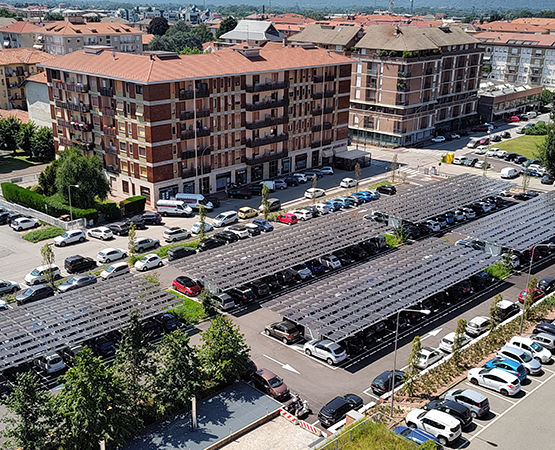
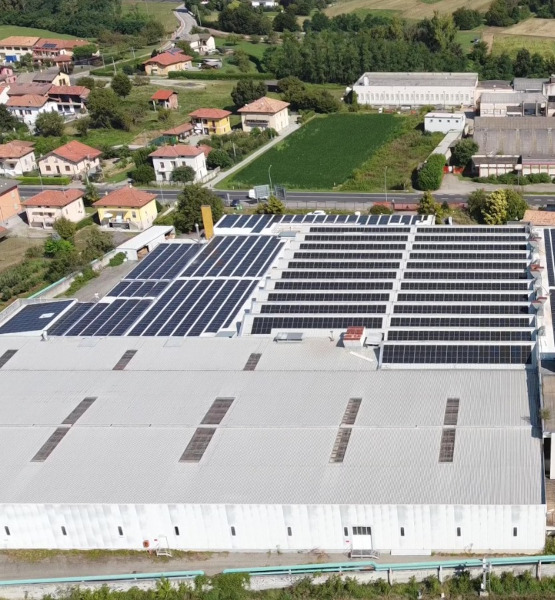
- self-generation of electricity from renewable sources, with a total installed capacity of approximately 17 MW by 2026. Based on the estimates carried out, such installed capacity could generate an annual amount of electricity substantially equivalent to the Group's total consumption;
- monitoring of avoided emissions thanks to the Group’s renewable electricity generation facilities, both for the portion intended for self-consumption and for the portion sold to the grid operator. Therefore, a target is established for a 75% reduction in “adjusted” Location-Based emissions, namely emissions measured by fully considering self-generation.
To achieve these objectives, the Group has defined and started a transition plan that is based on the following decarbonization levers:
- conversion of fossil fuel boilers through the installation of electric heat pumps serving the headquarters and branches;
- modernization of the heat distribution network in the headquarters;
- replacement of the type of refrigerant gas used in the air conditioning systems of headquarters and branches with one with a lower environmental impact;
- containment of energy consumption and energy efficiency;
- production of electricity from renewable sources through owned plants;
- reduction of the environmental impact of corporate mobility.
In parallel, since 2021, Sella has decided to support certified climate mitigation projects through the purchase and retirement of carbon credits associated with the volume of residual CO₂ emissions calculated using the location-based methodology arising from its own operations, therefore excluding financed emissions deriving from the customer portfolio. For the calculated residual emissions, carbon credits linked to selected projects have been purchased and retired, with certification provided by third parties according to international standards such as the Verified Carbon Standard (VCS) and Gold Standard.
During the three-year period 2021-2023, Sella Group financed three initiatives in Europe, Africa and Central America relating to certified projects focused on forest conservation, the protection of natural ecosystems, and plastic collection and recovery activities.
For the three-year period 2024-2026, the Group has decided to support the following projects, whose environmental and social impacts are described in greater detail in the following paragraphs:
- in India: two projects, one for the generation of renewable wind energy and one for photovoltaic energy, aimed at reducing dependence on fossil fuels;
- in Kenya: a project for the distribution of efficient cookstoves which, according to the project documentation, contributes to the reduction of emissions and exposure to smoke generated by the preparation of daily meals.
Sella Group monitors updates to the analyses of the environmental and social impacts related to the financed projects, as well as reputational aspects that may arise from different sources. Furthermore, it carefully monitors developments in the voluntary carbon credit market and, from time to time, evaluates the evolution of its offsetting strategy in line with the consolidation of best practices.
